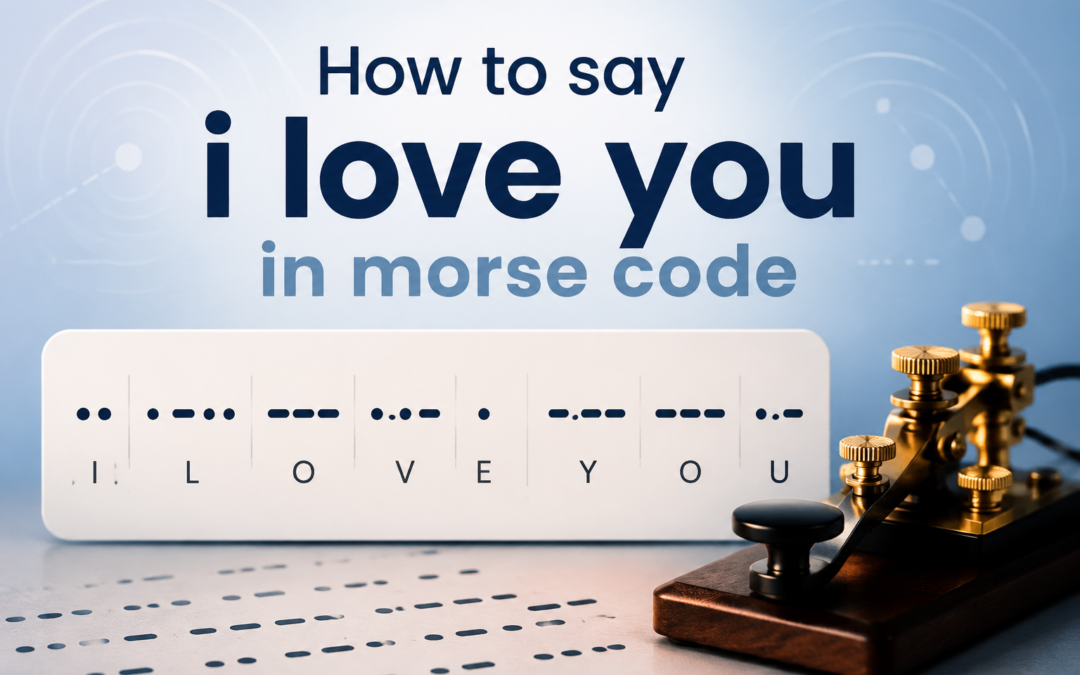
If you want to know how to say i love you in morse code, the direct translation is .. / .-.. — …- . / -.– — ..-. It looks simple, but those dots, dashes, spaces, and slashes matter because Morse code depends on timing and separation. Whether you want to send a romantic text, engrave a bracelet, tap out a secret message, or learn a classic communication system, this phrase is one of the most meaningful places to start. In this guide, you will learn the exact Morse code for “I love you,” how each letter works, how to write it correctly, how to signal it by sound or light, and how to avoid common mistakes. You will also see practical examples, use cases, best practices, and clear answers to common questions so you can share the message confidently.
The Exact Morse Code For I Love You
The phrase “I love you” is written in Morse code by translating each letter individually and separating each word clearly.
1. The Letter I
The letter I in Morse code is two dots, written as ... It is one of the shortest and easiest Morse letters to remember. In the full phrase, it appears alone as the first word, so it should be separated from the next word with a clear word gap.
2. The Word Love
The word “love” becomes .-.. — …- . in Morse code. Each letter has its own pattern, and the spaces between letters are important. Without those spaces, the message can become confusing because Morse code is read by grouping dots and dashes into separate letters.
3. The Word You
The word “you” becomes -.– — ..- in Morse code. The letter Y is longer than many beginners expect, while O is three dashes and U is two dots followed by a dash. Together, they create a clear ending to the romantic phrase.
4. The Complete Phrase
The complete Morse code for “I love you” is .. / .-.. — …- . / -.– — ..-. The slashes are commonly used in writing to show spaces between words. They are not spoken aloud, but they help readers see where one word ends and the next begins.
5. The Correct Spacing
Correct spacing is what makes the phrase readable. Use spaces between letters and a slash or wider gap between words. If you write .. .-.. — …- . -.– — ..- without word breaks, someone may still decode it, but it is less clean and less beginner-friendly.
6. The Short Romantic Version
Some people use “143” as a symbolic shortcut for “I love you,” but that is not Morse code. If you want the authentic Morse version, use the full translation. It is more precise, more traditional, and better for jewelry, cards, messages, or learning practice.
How Morse Code Works For Love Messages
Morse code uses short and long signals to represent letters, numbers, and punctuation. For love messages, it turns words into a pattern that feels personal and timeless.
1. Dots Are Short Signals
A dot is the shortest sound, blink, tap, or mark in Morse code. When sending “I love you,” dots appear often, especially in I, L, V, E, and U. If you are tapping the message, keep each dot quick and consistent so the rhythm stays readable.
2. Dashes Are Long Signals
A dash is longer than a dot, usually about three times its length. In “I love you,” dashes appear in L, O, V, Y, and U. Making dashes too short is a common reason Morse messages become hard to understand, especially for beginners.
3. Letters Need Small Gaps
Each letter must be separated by a short pause or written space. For example, the letters in “love” should not run together. The reader needs to see or hear where L ends and O begins, or the emotional message may turn into a decoding puzzle.
4. Words Need Bigger Gaps
Words require a longer pause than letters. In written Morse, a slash often represents that word gap. In sound or light, the pause after “I” and after “love” should be clearly longer than the pauses between letters inside each word.
5. Rhythm Helps Recognition
Morse code is easier to understand when the rhythm is steady. Instead of rushing through the phrase, practice it slowly until the dot and dash lengths feel natural. A steady rhythm makes “I love you” sound intentional rather than random.
6. Written Morse Is Most Forgiving
Writing Morse code is easier than sending it by sound, light, or tapping because the reader can study the symbols. If you are using Morse for a card, engraving, or text message, written form gives you the best chance of being understood correctly.
How To Write I Love You In Morse Code
Writing the phrase correctly is simple when you follow a clean process and check each letter before sharing it.
- Write The Words: Start with the plain English phrase “I love you” so you know exactly what you are translating.
- Translate I: Change the letter I into .. and keep it as its own word.
- Translate Love: Change L to .-.., O to —, V to …-, and E to ..
- Translate You: Change Y to -.–, O to —, and U to ..-.
- Add Letter Spaces: Place a space between each Morse letter so the phrase stays readable.
- Add Word Breaks: Use slashes between words when writing the phrase for someone else.
- Review The Final Version: Check that the finished phrase reads .. / .-.. — …- . / -.– — ..-.
Meaning Of I Love You In Morse Code
The meaning does not change when the phrase becomes Morse code, but the format can make the message feel more private, creative, and memorable.
1. It Keeps The Same Romantic Meaning
Morse code is only a different way to represent language, so “I love you” still means a direct expression of love, care, and affection. The code does not make the phrase less emotional. In many cases, it makes the message feel more thoughtful.
2. It Adds A Secret Message Feeling
Because many people do not instantly read Morse code, the phrase can feel like a hidden note between two people. This makes it popular for couples who enjoy private symbols, personal jokes, meaningful jewelry, or messages that are not obvious at first glance.
3. It Connects Romance With History
Morse code has a long communication history, so using it for a love message gives the phrase an old-fashioned charm. It can suggest distance, patience, and effort, which are all ideas people often associate with meaningful relationships and heartfelt messages.
4. It Works Across Many Formats
The phrase can be written, tapped, blinked, flashed with a light, printed on a card, or engraved into a gift. That flexibility makes it useful when you want a message that can be shared visually, physically, or through sound.
5. It Feels More Personal Than Plain Text
A normal “I love you” text is clear, but Morse code adds an extra layer of intention. The sender has to translate or choose the code carefully, and the receiver may need to decode it, making the exchange feel more interactive.
6. It Can Become A Shared Symbol
Once two people know the phrase, .. / .-.. — …- . / -.– — ..- can become a private relationship symbol. It may appear on notes, rings, bracelets, artwork, or small reminders without needing to explain the full message every time.
Examples Of I Love You In Morse Code
Examples help you choose the right format for your situation, especially when the message needs to look clean or be easy to decode.
Written On A Card
For a card, write .. / .-.. — …- . / -.– — ..- clearly on one line. You can add the plain English meaning elsewhere if the person is new to Morse code, but the coded phrase alone works well when the receiver already knows the meaning.
Sent In A Text Message
In a text message, the slash format is usually best because phone spacing can be inconsistent. Sending .. / .-.. — …- . / -.– — ..- keeps the words separated and avoids confusion. It also looks neat on most screens.
Tapped On A Table
When tapping, use quick taps for dots and longer taps for dashes. Pause briefly between letters and longer between words. Start slowly, because tapping too fast can make the phrase hard to follow even when the code itself is correct.
Flashed With A Light
For a flashlight message, make short flashes for dots and longer flashes for dashes. Leave clear pauses between letters and words. This method can be romantic in a playful setting, but it works best when both people already understand the timing.
Engraved On Jewelry
For jewelry, the phrase can be engraved as dots, dashes, beads, bars, or tiny marks. Make sure the word breaks are visible. A design may look attractive, but if the spacing disappears, the Morse code can become difficult to read accurately.
Used In Artwork
Morse code can be included in posters, handwritten notes, wall art, or custom gifts. The pattern can be subtle while still carrying a clear message. For decorative use, balance beauty with accuracy so the romantic phrase remains correct.
Benefits Of Saying I Love You In Morse Code
Using Morse code for a love message is not only about novelty. It can make the phrase feel more intentional and memorable.
- Personal Touch: It shows extra effort because the sender chose a coded form instead of a plain message.
- Private Meaning: It can feel discreet when only the sender and receiver know what the dots and dashes mean.
- Creative Format: It works beautifully for cards, crafts, jewelry, artwork, tattoos, and keepsakes.
- Easy To Learn: The phrase uses common Morse letters, so beginners can memorize it with practice.
- Timeless Feel: Morse code gives a simple romantic message a classic communication style.
- Flexible Delivery: You can write it, tap it, blink it, flash it, print it, or engrave it.
Common How To Say I Love You In Morse Code Mistakes To Avoid
Small mistakes can change the message or make it unreadable, so accuracy matters when writing or sending the phrase.
1. Removing The Word Spaces
If you remove the word spaces, the phrase becomes harder to read. Morse code depends on separation, not just symbols. Use slashes in written form or longer pauses in signals so the receiver can recognize “I,” “love,” and “you” as separate words.
2. Mixing Up Y And U
The word “you” includes Y and U, which beginners sometimes confuse. Y is -.–, while U is ..-. Double-checking these two letters prevents the final word from becoming incorrect, especially in engraving or permanent designs.
3. Making Dashes Too Short
When sending Morse by sound, light, or tapping, dashes must be noticeably longer than dots. If every signal has the same length, the receiver cannot reliably tell the letters apart. Slow, deliberate timing is better than a fast but unclear message.
4. Using Decorative Spacing Only
Decorative Morse designs can look elegant, but they still need readable spacing. If dots and dashes are arranged only for visual balance, the code may lose its meaning. Always review the design as a message before treating it as decoration.
5. Forgetting One Letter In Love
The word “love” has four Morse letters: L, O, V, and E. Missing the final dot for E is a common visual mistake because it looks small. That tiny dot matters, so include it clearly when writing, printing, or engraving the phrase.
6. Assuming Everyone Can Decode It
Morse code is familiar to many people, but not everyone can read it quickly. If the message needs to be immediately understood, include the plain meaning nearby. If the goal is mystery, then the coded version alone may be exactly right.
Best Practices For How To Say I Love You In Morse Code
These best practices help you make the message accurate, readable, and meaningful in any format.
Use The Standard Translation
Stick with .. / .-.. — …- . / -.– — ..- for the full phrase. Creative variations can be fun, but the standard translation is safest when you want the message to be recognized by people who understand Morse code.
Keep The Symbols Clean
Use simple dots, dashes, and spaces when clarity matters. Fancy marks can work, but they should still be easy to distinguish. If a dash looks too much like a dot, the reader may decode the message incorrectly.
Practice Before Sending By Signal
If you plan to tap, blink, or flash the phrase, practice the rhythm first. Written Morse can be checked visually, but live signals depend on timing. A few slow practice runs will make the final message much easier to understand.
Add A Translation When Needed
If the receiver may not know Morse code, include “I love you” nearby or explain it afterward. This keeps the message sweet rather than frustrating. A coded message should create delight, not leave someone confused at an important moment.
Check Permanent Designs Carefully
For tattoos, rings, bracelets, or wall art, verify the code before finalizing anything permanent. One missing dot or misplaced dash can change the result. It is worth reviewing the phrase several times before approving a design.
Match The Format To The Moment
A text message, gift, handwritten note, and light signal each create a different feeling. Choose the format that fits the relationship and setting. The best version is not always the most complex one, but the one that feels sincere.
Practical I Love You In Morse Code Use Cases
The phrase works in many real-life situations, from simple messages to personal keepsakes.
1. Romantic Notes
Morse code works well in handwritten notes because it adds a hidden layer to a familiar phrase. You can place the coded version at the end of a letter, inside a card, or beside a simple message for a personal touch.
2. Couple Jewelry
Bracelets, necklaces, and rings often use beads or engraved marks to represent Morse code. “I love you” is a strong choice because the meaning is intimate while the design can remain subtle enough for daily wear.
3. Wedding Details
Couples sometimes include Morse code in vows, invitations, table cards, cufflinks, or keepsakes. It can make a wedding detail feel personal without being overly obvious. The phrase also works well as a quiet symbol shared between partners.
4. Long Distance Messages
Morse code has a natural connection to distance and communication, which makes it meaningful for long-distance couples. Sending the phrase by text, audio, or light can turn a simple message into something more memorable.
5. Tattoos And Keepsakes
A Morse code tattoo or keepsake can represent love in a minimal design. Because the phrase is symbolic, it may feel more private than a written sentence. Accuracy is especially important because permanent designs are difficult to correct.
6. Learning Activities
Teachers, parents, and hobbyists can use “I love you” as a friendly beginner phrase for learning Morse code. It is short enough to practice, meaningful enough to remember, and useful for showing how letters and word gaps work.
Advanced I Love You In Morse Code Tips
Once you know the basic translation, these tips can help you use the phrase with more confidence and polish.
1. Learn The Letter Patterns Separately
Instead of memorizing the phrase as one long string, learn I, L, O, V, E, Y, and U separately. This makes the code easier to remember and helps you notice mistakes when writing or signaling the phrase later.
2. Say The Rhythm Out Loud
Some learners remember Morse better by saying “dit” for dots and “dah” for dashes. Speaking the rhythm can make the phrase easier to internalize before tapping or flashing it. This is especially helpful for live signaling.
3. Use Consistent Word Breaks
In written Morse, choose one word-break style and keep it consistent. Slashes are the clearest option for most readers. In visual art, you can use wider spacing, but it should still be obvious where each word begins and ends.
4. Test It With A Reader
Before using the phrase in an important gift or design, ask someone familiar with Morse code to read it. A second set of eyes can catch spacing mistakes, missing dots, or reversed letters that may be easy to overlook.
5. Keep Decorative Versions Simple
Minimal designs often work better than crowded ones. A clean row of dots and dashes is easier to decode than a heavily stylized design. If the message matters, readability should guide the design choices.
6. Pair It With Plain Language
For emotional moments, Morse code can be paired with a normal “I love you” instead of replacing it completely. This gives you both the charm of the code and the clarity of direct language, which often creates the strongest effect.
Key I Love You In Morse Code Factors
Several factors affect whether your Morse code message is accurate, attractive, and easy to understand.
- Accuracy: Every dot and dash must match the correct letter translation.
- Spacing: Letter spaces and word gaps make the phrase readable.
- Timing: Signals by sound, tapping, or light need consistent rhythm.
- Context: A private gift may need less explanation than a public message.
- Format: Text, jewelry, tattoos, and signals each require different levels of clarity.
The Lasting Appeal Of Morse Code Love Messages
Morse code love messages remain popular because they combine simplicity with hidden meaning. A few dots and dashes can carry a full emotional sentence, which makes the format feel both minimal and deeply personal.
The phrase also invites participation. The receiver may pause, decode it, ask about it, or recognize it instantly. That small moment of discovery can make the message more memorable than a normal written phrase.
Another reason it works is that Morse code feels timeless. It comes from a history of long-distance communication, so using it for love naturally suggests connection across space, silence, or separation.
At the same time, it fits modern life easily. You can send it in a text, engrave it on a gift, turn it into a pattern, or use it as a private symbol without needing special equipment.
The best Morse code love messages are simple, correct, and sincere. When the phrase is accurate and the presentation fits the moment, the code becomes more than a novelty. It becomes a compact way to say something important.
Frequently Asked Questions
What Is I Love You In Morse Code?
“I love you” in Morse code is .. / .-.. — …- . / -.– — ..-. The dots and dashes represent individual letters, while the slashes show spaces between words. This written format is the clearest version for texts, cards, engravings, and learning.
How Do You Tap I Love You In Morse Code?
Use short taps for dots and longer taps for dashes. Tap .. for I, pause longer, then tap the letters in love, pause again, and tap the letters in you. Keep the rhythm slow and steady so the receiver can separate letters and words.
Can I Use Morse Code For A Gift?
Yes, Morse code works very well for gifts such as bracelets, rings, cards, artwork, and keepsakes. The phrase is short enough to fit many designs. Just make sure the dots, dashes, and word spaces remain clear, especially for permanent or custom items.
Is 143 The Same As I Love You In Morse Code?
No, 143 is a numeric shorthand where the numbers represent the letter count in “I love you.” It is a popular romantic symbol, but it is not Morse code. The true Morse code version uses dots and dashes for each letter.
Do Spaces Matter In Morse Code?
Yes, spaces are essential in Morse code. Without spaces, dots and dashes can run together and become difficult to decode. Use small spaces between letters and larger gaps or slashes between words when writing “I love you” in Morse code.
Is Morse Code Hard To Learn?
Morse code takes practice, but simple phrases are easy to start with. “I love you” is a good beginner phrase because it uses several common letters and has a memorable meaning. Learning the individual letter patterns makes the full phrase easier to remember.
Conclusion
Now you know the exact Morse code for “I love you” is .. / .-.. — …- . / -.– — ..-. You also know how the dots, dashes, letter spaces, and word breaks work, and why accuracy matters when writing, tapping, flashing, engraving, or designing the message.
Morse code turns a familiar phrase into something personal, subtle, and memorable. Whether you use it in a text, a card, a gift, or a private symbol, the best approach is to keep the translation correct, the spacing clear, and the meaning sincere.