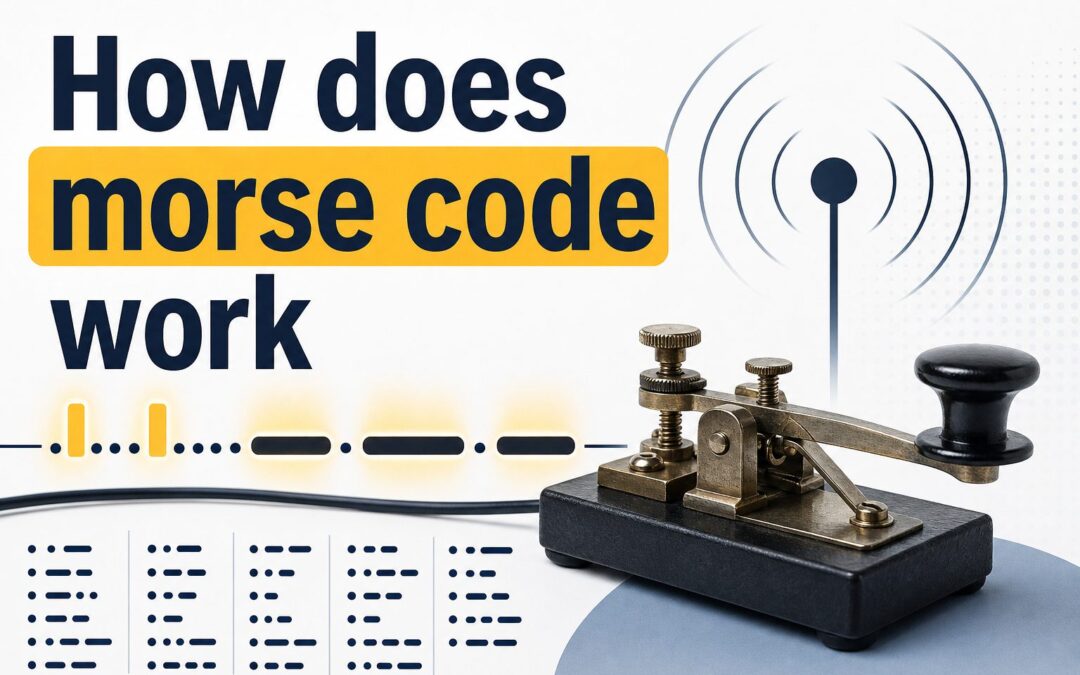
How does morse code work is a common question because the system looks simple at first, yet it has a precise structure behind every dot, dash, pause, word, and message. Morse code is a method of sending letters, numbers, and basic punctuation through short and long signals. These signals can be heard as sounds, seen as flashes of light, felt as taps, or transmitted by radio. Although it was created for telegraph communication, it still matters today in aviation, amateur radio, emergency signaling, survival training, accessibility, and technical hobbies. In this guide, you will learn what Morse code means, how the timing works, how letters are formed, how to read and send messages, where it is used, which mistakes to avoid, and how beginners can practice it in a practical way.
What Morse Code Means
Morse code is a communication system that turns written characters into patterns of short and long signals. It works because both sender and receiver follow the same code chart and timing rules.
1. Dots Represent Short Signals
A dot is the shortest basic signal in Morse code. It is often written as a small period and pronounced as “dit” when spoken aloud. Dots are important because they create quick, sharp parts of a character and help distinguish letters such as E, I, S, and H.
2. Dashes Represent Long Signals
A dash is a longer signal, usually three times the length of a dot. It is often written as a hyphen and pronounced as “dah.” Dashes add contrast to the code, making letters like T, M, O, and G easy to recognize when timing is clear.
3. Characters Are Built From Patterns
Every letter and number has its own combination of dots and dashes. For example, A is dot dash, while N is dash dot. The receiver does not decode each signal alone, but listens to the full pattern and matches it to a known character.
4. Spaces Separate Letters And Words
Morse code depends on silence as much as sound or light. A short pause separates parts of one letter, a longer pause separates letters, and an even longer pause separates words. Without these spaces, even correct dot and dash patterns can become confusing.
5. Timing Gives Morse Code Its Meaning
The length of each signal and pause determines how the message is read. If dots, dashes, and spaces are not timed correctly, letters may blend together. Good Morse code is not just about memorizing patterns; it is also about steady rhythm.
6. The Same Code Can Use Different Signals
Morse code does not require one specific device. The same message can be sent with a telegraph key, radio tone, flashlight, whistle, buzzer, mirror flash, or hand tap. This flexibility is one reason it remains useful in unusual communication situations.
How Morse Code Works
Morse code works by converting normal text into signal patterns, sending those patterns through a medium, and decoding them back into readable language.
A Message Is Broken Into Characters
The sender begins with a plain message and breaks it into individual letters, numbers, or punctuation marks. Each character is then matched with its Morse pattern. This step is simple in writing, but with sound it becomes a skill of recognition and rhythm.
Each Character Becomes Dots And Dashes
After the message is divided, every character is represented by dots and dashes. The letter S becomes three dots, while O becomes three dashes. These patterns are short enough to send quickly but different enough to recognize with practice.
Signals Are Sent In A Clear Sequence
The sender transmits each dot and dash in the proper order. A single reversed signal can change the meaning of a letter, so sequence matters. For example, dot dash means A, but dash dot means N, even though both use the same two signal types.
Pauses Show Where Symbols End
Pauses tell the receiver whether the next signal belongs to the same letter, a new letter, or a new word. This is one of the most important parts of how Morse code works, because silence acts like spacing in written language.
The Receiver Recognizes Complete Patterns
Experienced receivers do not count every dot and dash slowly. They learn to hear each letter as a complete sound pattern. This is similar to recognizing a word by its shape instead of spelling it letter by letter every time.
The Message Is Rebuilt As Text
Once the receiver identifies each character, the message is rebuilt into normal writing. Accuracy depends on clear sending, correct spacing, and familiar patterns. With enough practice, Morse code can become surprisingly fast and natural to read.
Why Morse Code Still Matters
Morse code is no longer the main system for global communication, but it still has value because it is reliable, compact, and easy to transmit with simple tools.
- Emergency Communication: Morse code can be sent with sound, light, or movement when speech or modern devices fail.
- Radio Use: Amateur radio operators still use Morse code because it can travel far with low power and narrow bandwidth.
- Survival Skills: Simple signals such as SOS can help people attract attention during outdoor emergencies.
- Accessibility: Some assistive technologies can use Morse-style input for people with limited movement.
- Historical Value: Learning Morse code helps people understand telegraphy, early radio, and the development of long-distance communication.
Morse Code Symbols And Timing
The code is easy to write down, but timing is what makes it understandable in real communication. The standard rhythm keeps every message readable.
One Dot Is The Basic Unit
The dot is the foundation of Morse timing. A dot lasts for one unit of time, and all other signal lengths are measured against it. Whether the sender is slow or fast, the relationship between dots, dashes, and spaces should stay consistent.
One Dash Equals Three Dots
A dash should last about three times as long as a dot. This clear difference helps the receiver hear or see whether the signal is short or long. If dashes are too short, they may be mistaken for dots and create decoding errors.
Parts Of A Letter Have Short Gaps
Within one letter, the space between dots and dashes is brief. This small pause keeps each element separate without suggesting a new letter. For example, the three dots in S need tiny spaces between them, but they still belong together.
Letters Need Longer Gaps
After one letter is complete, the sender leaves a longer pause before the next letter. This pause is usually three dot units. It tells the receiver that one pattern has ended and another pattern is about to begin.
Words Need The Longest Gaps
The space between words is longer than the space between letters. This pause is usually seven dot units. Without word spacing, a message may still be decoded letter by letter, but it becomes much harder to read naturally.
Speed Must Stay Consistent
Fast Morse code is not useful if the rhythm is uneven. A steady pace helps the receiver predict timing and recognize patterns. Beginners should focus on clean spacing before speed, because accuracy matters more than sending many characters per minute.
How To Learn Morse Code Step By Step
Learning Morse code is easier when you build recognition gradually instead of trying to memorize the entire chart in one sitting.
- Start With Common Letters: Learn simple and frequent letters such as E, T, A, N, I, and M first.
- Practice By Sound: Listen to the rhythm instead of only reading dots and dashes on paper.
- Learn Small Groups: Add a few new characters at a time so your memory stays organized.
- Write Short Words: Practice common words to connect individual letters into useful messages.
- Use Proper Spacing: Train pauses from the beginning so your sending does not become unclear.
- Review Daily: Short daily sessions are better than rare, long practice sessions.
- Test Real Messages: Decode sentences, names, and numbers to build practical confidence.
Examples Of Morse Code
Examples make Morse code easier to understand because they show how written language changes into signal patterns.
1. SOS As A Distress Signal
SOS is written as three dots, three dashes, and three dots. It is famous because it is simple, balanced, and easy to recognize under stress. The letters themselves are less important than the clear repeated pattern used for emergency attention.
2. The Letter A
The letter A is dot dash. It is a useful beginner letter because it shows how a short signal followed by a long signal creates a complete character. Many learners use A to practice the difference between dot and dash timing.
3. The Letter N
The letter N is dash dot, which is the reverse of A. This makes it a good example of why order matters in Morse code. The same two signal types can mean different letters when their sequence changes.
4. The Word Hi
The word HI is often used by beginners and radio operators because it is short and friendly. H is four dots, and I is two dots. When sent with correct spacing, the receiver hears two separate letters rather than one long string of dots.
5. Numbers In Morse Code
Numbers also have Morse patterns, and they usually contain five signals each. For example, 1 begins with a dot followed by four dashes, while 5 is five dots. Number patterns are useful for times, coordinates, call signs, and technical messages.
6. Names And Short Messages
Personal names are excellent practice because they combine familiar letters in meaningful ways. Sending a name forces the learner to manage multiple letters, pauses, and rhythm. Short messages also make practice more realistic than memorizing isolated symbols.
Practical Morse Code Use Cases
Morse code appears in more real-world situations than many people expect. Its strength is that it can work through very basic signals.
1. Amateur Radio Communication
Many amateur radio operators use Morse code, often called CW in that context, because it can be effective with weak signals and modest equipment. It also requires less bandwidth than voice, making it useful when radio conditions are difficult.
2. Emergency Light Signaling
A flashlight can send Morse code across distance at night or in low visibility. This is useful when a person cannot shout far enough or needs to conserve energy. Simple signals work best because they reduce the chance of confusion.
3. Sound And Whistle Signals
Morse code can be sent through whistles, horns, or repeated knocks. This makes it useful when visual contact is poor but sound can travel. The sender still needs clear rhythm so the receiver can separate dots, dashes, letters, and words.
4. Aviation And Navigation History
Morse code has long been connected with aviation and radio navigation identifiers. Even where newer systems dominate, the code remains part of communication history and technical literacy. It shows how compact signals helped operators identify stations and transmit information.
5. Assistive Input Methods
Some accessibility systems can use Morse-style input because dots and dashes require only a small number of actions. A person may enter text with one or two switches, making Morse code useful beyond radio and emergency communication.
6. Education And Brain Training
Morse code is also used as a learning exercise. It builds pattern recognition, listening skill, memory, timing, and concentration. Students often find it interesting because it connects language, sound, history, technology, and problem solving in one compact system.
Common Morse Code Mistakes To Avoid
Most Morse code mistakes come from rushing, uneven timing, or relying too heavily on written charts instead of pattern recognition.
1. Counting Instead Of Recognizing Patterns
Beginners often count every dot and dash, but this becomes slow and tiring. A better approach is to learn each character as a sound pattern. With practice, the brain recognizes the rhythm directly instead of translating every signal one by one.
2. Sending Dashes Too Short
If dashes are not clearly longer than dots, the receiver may misread the message. A dash should feel noticeably longer, not just slightly stretched. Practicing with a steady beat helps beginners keep the difference clear and reliable.
3. Ignoring Spaces Between Letters
Many learners focus on dots and dashes but forget that spaces carry meaning. If letters are too close together, separate characters can merge into confusing patterns. Proper spacing makes even slow Morse code easier to understand.
4. Practicing Only On Paper
Reading written Morse code is helpful, but real communication is often heard or seen as timed signals. Learners who only study charts may struggle with audio recognition. Listening practice should begin early, even at a slow speed.
5. Trying To Learn Too Fast
Speed should come after accuracy. When learners rush, they often build poor rhythm and weak recognition habits. Short, focused practice sessions create better results because the patterns become familiar without overwhelming memory.
6. Forgetting Numbers And Punctuation
Letters are the foundation, but numbers and basic punctuation are also useful. Messages often include times, locations, call signs, or measurements. Learning these after the alphabet makes Morse code more complete and practical.
Best Practices For Learning Morse Code
The best way to learn Morse code is to combine memory, listening, rhythm, and real message practice.
1. Learn By Ear First
Sound-based learning helps you recognize Morse code as a language of rhythm rather than a visual puzzle. Even if you plan to use light signals, audio practice trains timing and pattern recognition in a direct, reliable way.
2. Keep Practice Sessions Short
Ten to fifteen focused minutes can be more useful than an hour of tired repetition. Morse code depends on attention and memory, so short sessions help you stay accurate while gradually building confidence and speed.
3. Use Real Words Early
Practicing real words makes the code more meaningful. Instead of memorizing random characters forever, start decoding names, greetings, weather terms, and simple sentences. This helps your brain connect patterns with practical communication.
4. Master Spacing Before Speed
Clear spacing makes messages readable at any speed. If your pauses are inconsistent, even correct letters may sound wrong. Practice with a metronome-like rhythm until dots, dashes, letters, and words feel naturally separated.
5. Review Difficult Characters Often
Some letters are easy to confuse, especially reversed patterns such as A and N or similar groups with several dots. Make a small review list of troublesome characters and practice them until they become automatic.
6. Send And Receive Together
Receiving helps you recognize patterns, while sending helps you understand structure and timing. Practicing both skills creates a stronger foundation than doing only one. Even simple tapping exercises can improve control and confidence.
Morse Code History And Modern Value
Morse code began as a practical answer to a major communication problem: how to send information quickly across long distances before telephones, radio voice, and digital networks were common.
The system became closely tied to the electric telegraph, allowing operators to send messages through pulses over wires. This changed business, journalism, transportation, military communication, and personal messages because information no longer had to travel physically by horse, ship, or train.
Later, Morse code moved into radio communication, where it became valuable for ships, aircraft, and remote stations. Its simple signal structure made it more dependable than complex voice transmission in some poor conditions.
Today, Morse code is no longer required for most everyday communication, but it remains respected because of its elegance and resilience. A person with basic equipment can still send a meaningful message across distance using only timed signals.
The modern value of Morse code is not only historical. It teaches discipline, listening, timing, and efficient communication. It also reminds us that a message does not need advanced technology to be clear when the system behind it is well designed.
Frequently Asked Questions
Is Morse Code Hard To Learn?
Morse code is not hard to begin, but it takes practice to use smoothly. Most people can learn simple letters and SOS quickly. The challenge is recognizing patterns by sound, keeping steady timing, and reading longer messages without stopping to count every dot and dash.
What Is The Difference Between A Dot And A Dash?
A dot is a short signal, while a dash is a longer signal. In standard timing, a dash lasts about three times as long as a dot. This length difference is essential because many Morse code characters depend on the contrast between short and long signals.
Can Morse Code Be Sent With Light?
Yes, Morse code can be sent with light by using short flashes for dots and longer flashes for dashes. A flashlight, signal lamp, or mirror can work. The sender must also use clear pauses between signals, letters, and words so the message can be read correctly.
Why Is SOS Used In Morse Code?
SOS is widely known because its Morse pattern is simple and easy to recognize: three short signals, three long signals, and three short signals. It became associated with distress because it is clear, memorable, and practical during emergencies when fast recognition matters.
Do People Still Use Morse Code Today?
Yes, people still use Morse code, especially in amateur radio, training, emergency signaling, historical demonstrations, and some accessibility systems. It is not the main form of communication anymore, but it remains useful because it can work with very simple equipment.
What Is The Best Way To Practice Morse Code?
The best way to practice is to listen to characters as sound patterns, review a few letters at a time, and decode short real messages. Focus on clean timing before speed. Daily practice, even for a few minutes, usually works better than occasional long sessions.
Conclusion
Morse code works by turning letters, numbers, and punctuation into timed patterns of dots, dashes, and pauses. The signals may be sent through sound, light, radio, or touch, but the basic system stays the same. Clear rhythm, correct spacing, and pattern recognition make the code readable.
Although Morse code comes from an earlier era of communication, it still offers practical lessons today. It is simple, flexible, and reliable when used correctly. For beginners, the best path is to learn the patterns slowly, practice by ear, and build speed only after accuracy feels natural.